
The Storm Before The Calm By George Friedman
The foundation of the American empire is not the military nor even the economy. It is rock and roll, T-shirts that say “Santa Barbara,” and New York Yankee baseball caps.
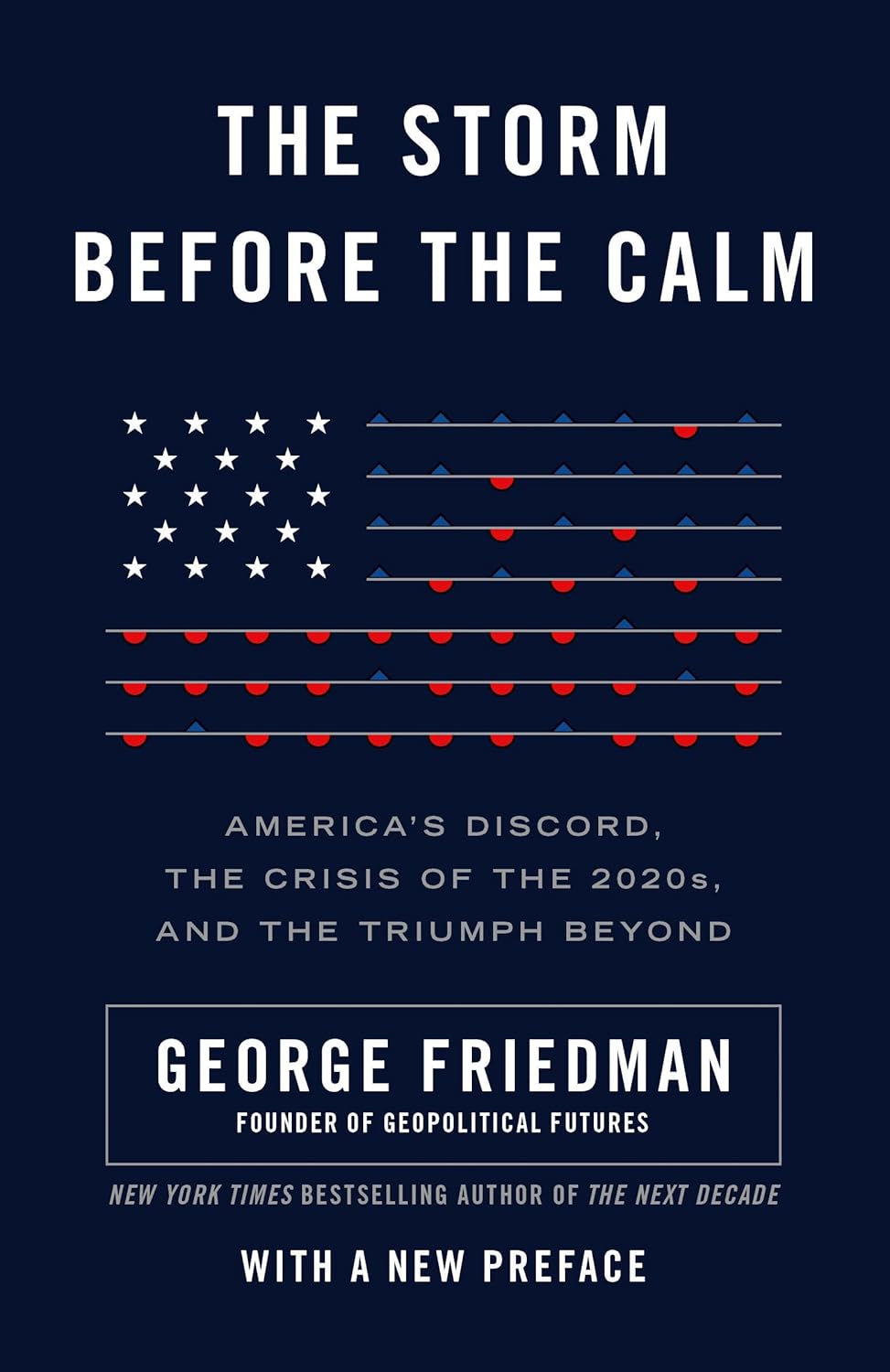
George Friedman argues in his 2020 book, The Storm Before the Calm, that the decade of the 2020s will be a political and economic storm for America, but that it is “nothing more than what is normal for this time in America’s history and our lives.” According to the author, America began a radically new era in 1992 that has still not been fully processed or understood. Historically successful empires have used as little military force as possible to meet their geopolitical goals, yet before 1992 force was the primary American go to play.
In 2026, the American nation will be 250 years old, and in that time it has gone from a third world country to a “behemoth astride the world.” However today the United States is living through a difficult time. American’s focus on Donald Trump as if he alone “were the problem or the solution.” This is not new. Civil War, snipers in Detroit, Abraham Lincoln and Richard Nixon all come to mind. The American president is often blamed, even though the president has little power compared with other nations prime ministers, facing two parliaments, the judiciary and 50 sovereign states. American goes through periodic and predictable crises and what Americans do is blame the president. Yet, the United States is an invented nation and the nation has more ability to change that other nations.
Part 1 of the book discusses the American character, Part 2 describes the two major cycles in detail (the institutional and the economic) and Part 3 ends with a forecast for the future.
In Part 1 of the book, Friedman covers the founding of the nation, and the unique geography of the nation, starting from the original colonies and the Seven Years' War. The strategic issue at the time was control of the Ohio Territory west of the Appalachians. This part of the war is unimportant to the British and the colonies themselves had to raise militias to fight the French and the Indians. Tension arose when the British finally showed up, and a breach between Britian and the colonies then came to exist, later leading to revolution. The American people came to embody various archetypes over the next couple centuries, the strongest of which are the Cowboy, the Inventor and the Warrior. And ever since the Manhattan Project, the miliary has been focus on basic science and scientist and invention as part of the war machine. The development of military technology lead to many technological revolutions after developed technology from the military entered the civilian section including: digital computers; GPS; the Internet and so on.
Part 2 covers the ~80 year institutional cycle and the ~50 year economic cycles in the United States. What has happened before is that the existing societal model breaks, political tension develops (and the president is blamed), change occurs and a new model is established. At each periodic crisis the United States appears to be at war with itself and at least once really was. In 1991 the Soviet Union collapsed and at the same time the United States became an empire, but not a formal empire. It is simply the most powerful agent in the world. The Communists were defeated through attrition. But the United States has small reason to build an economic empire as it exports only 13% of its GDP. Germany exports nearly 50%. Yet September 11th 2001 kept the war machine running into the 21st century. The pressure continual war put on the federal government plays a distinct role in the problems that are intensifying in the 2020s. The federal government is now outmoded and needs reform. The problem is not that the government has grown too large and in fact relative to population it has not kept up. The problems are rising debt and more fundamentally that the increasing level of federal involvement in society has grown beyond its institutional capabilities. Authority is diffused, problems are entangled with multiple federal agencies and there is not even an authoritative list of government agencies to be found. Institutions built on technocratic expertise no longer work well. Universities are inefficient, and the Internet is incoherent and harmful. The socioeconomic cycle is breaking as well. The Roosevelt cycle ended with a capital shortage and the Regan cycle while fixing that problem has left us with a middle class that can currently no longer afford middle class life. GDP has grown faster than median household income, and yet there is no a massive surplus of capital. Presidents in the 2020s will represent the values of the declining era and give rise to a rising class that will impose a new economic system sometime in the 2030s.
Part 3 - in the 2020s we have a crisis that is the Storm and the 2030s will lead to the solutions to bring back the Calm. President Obama's health-care act was around 897 documents with other 20,000 pages of regulations, and for most people the federal government is now incomprehensible. The technocracy and technocrats are at odds with the working class. There is now a crisis in housing, employment, real output per hour, universities, and more. The 2024 election elected a president who is the last of the Reagan cycle where the problem was capital shortage and the solution was lowering taxes and reducing regulations. These solutions will make matters worse instead of solving the problem. It is likely that the election of 2028 will lead to the introduction of radical new principles to American governance, both sociotechnical and institutional.
Friedman also predicts that the fourth intuitional cycle permitting the government to radically administer to issues at each level. Transforming universities will be important and the first battle will be over student loans. The university struggle will define politics of the 6th economic cycle. The health system and medical care also need change. Taxes on higher incomes will surge at the start of the next cycle, investment money will be tight, until the 2050s when times may change again. Friedman also doesn't predict global political action to address climate change.
It is nearly 250 years since the signing of the Declaration of Independence, and America has grown from a third world nation to a behemoth. The United States is an accidental empire, based on a radical view of government. We are in crisis now but we will deal with it like we always do, by raging at each other first and then eventually creating a new political solution. We all believe there has never been a time as tense as this one, but it isn't true. These problems work themselves out and America goes on. At least for the foreseeable future.