
Whatever Is Quantum Computing?
The trillion-dollar question is: Can we control decoherence?
I've see enough quantum computing (QC) news, governmental initiatives, investing advice, yolo longs and shorts and other hype to enjoy writing something on the topic. I will start by divide into two sections: financial, and the technicals.
THE FINANCIAL
2 Quantum Computing Stocks That could Make You a Millionaire from the Motley Fools hypes IonQ and D-Wave companies. The stocks closed +15.18% and +20.19% on 2/6/26. The post made on 2/7/26. 1 year performance is -15.22% and +245.91% respectively.
Governmental initiatives, funding and public/private company participation in Quantum has exploded. Microsoft, Google, IBM, Rigetti, Intel and others are building quantum computers now. The IBM Q experience makes real quantum computers available online to the public. In 2018 the U.S. Congress passed the National Quantum Initiative Act and US Governmental investments continue to roll in. The U.K, the Chinese, and others are also investing heavily. Future quantum application span the range of much of the world economy and include biological research, medical applications, global food supply, energy, and modeling of various very complicated things including global weather, fusion, the sun and so on.
So quantum investing is big-time! But, many quantum stocks bounce +/- 10% or so daily. Also big volatility.
There are even quantum themed ETFs now. QTUM from Defiance tracks an index and holds around 80 stocks and WisdomTree has another in WQTM. QTUM's tag line is "Invest in the Quantum Computing Revolution." Over the last year the ticker value of QTUM has ranged between $62 and $121.
QTUMs top 10 holdings (2/6/26)
1. Quantum Emotion Corp QNC CN
2. Micron Technology Inc MU
3. Teradyne Inc TER
4. Mks Inc MKSI
5. Lam Research Corp LRCX
6. Renesas Electronics Corp 6723 JP
7. Lockheed Martin Corp  LMT
8. Northrop Grumman Corp NOC
9. Asm International Nv ASM NA
10. Asml Holding Nv ASML
With Intel Corp (#12), Cisco (#38), Google (#43), Nvidia (#44), Microsoft (#63) all included as well. Other notables like Quantum Computing Inc and Regetti Computing Inc. are all the way down at #74 and #79 respectively. The Motley Fool single plays IonQ is #78 and D-Wave is #72.
A quick analysis (thank you Copilot and the STOCKHISTORY function) shows that the fund is primarily a large and mega cap focused technology/AI ETF with limited small cap exposure. The largest holding is 1.85%, making the ETF is a thin spread across all companies large and small in this space.
What are the applications for quantum? For now consider the applications of digital technologies, which of course are everywhere from food production to military hardware, and consider that quantum may have a play there. So the whole digital economy, including the crypto systems that run digital commerce.
THE TECHNICALS
Whatever is Quantum Computing?
I will answer in a few different ways.
- A quantum computer is a computer that uses quantum mechanics for computation.
- A quantum computer has a quantum processing unit that can perform quantum operations when programmed in a quantum programming language.
- a quantum computer executes a quantum (or hybrid) stack to deliver a solution for an application of a quantum algorithm
#1
A bit in classical computing is analogous to a switch. It can be ON or OFF and considered as values 1 or 0. A quantum bit (or qubit) is a two-level quantum mechanical system that can be represented mathematically as a two-dimensional complex Hilbert space. For our present purposes we can just consider the difference to be that a lot more math is available in these two-complex dimensions than a simple ON/OFF switch.
Quantum mechanical properties can be leveraged for computation such as: superposition and entanglement. Quantum systems are in an indefinite state until they are measured, and superposition is a linear combination of at least two state vectors of a quantum system that determines another state of the system according to the Born rule. Entanglement defines a specific kind of superposition (non-separable) that we won't go over here and now, but was mocked once as "spooky action at a distance" (see EPR/Bell).
John Preskill of CalTech coined a term for the era of quantum computing we are in today: NISQ. It stands for Noise Intermediate-Scale Quantum. Our current hardware has dozen to thousands of qubits but not the 1-million plus necessary for fault-tolerant and really interesting computing yet. Fault tolerance and error correction are a major push today to enable real-world quantum applications.
#2
This begs the question what are quantum programming languages / development platforms / compilers etc.
The Unitary foundation release a 2025 survey that listed the Top 5:
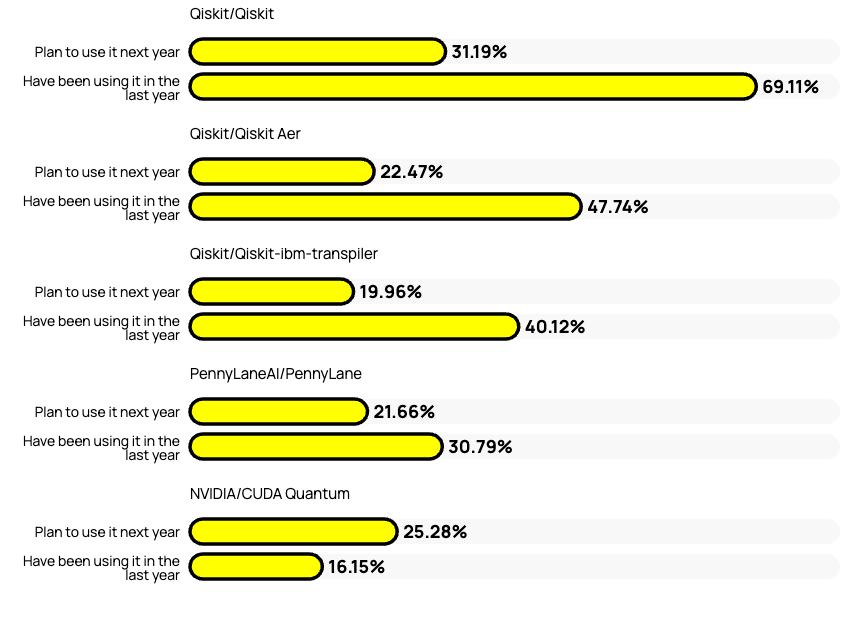
These are from (1) IBM, (2) IBM, (3) IBM, (4), Xanadu (private and based in Toronto), and (5) NVIDIA.
Intel (Intel Quantum Simulator), Google (quantumlib/Cirq), and Microsoft (Q#), are outside of the top 5. 95.7% use Python with C/C++ at 27.8%.
The main tasks of those responding to the survey are Application development and Algorithm development.
See more at Unitary Foundation 2025 Quantum Survey.
#3
Quantum algorithms are often depicted in quantum circuits. A visual representation of the state of the system can also be what is known as the Block Sphere.
I will show a program below that is toy program simple, yet powerful enough to show the incredible value of quantum computation. We will see how to generate a truly random bit in a single operation.
Classical computing use Pseudo-Random Number Generators (PRNGs) (algorithms) to seed and generate (hopefully) nearly random numbers for applications like encrypted systems.
But In Quantum and according to the known laws of Quantum Mechanics, the readout of a qubit in superposition is perfectly unpredictable, i.e. random.
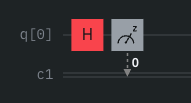
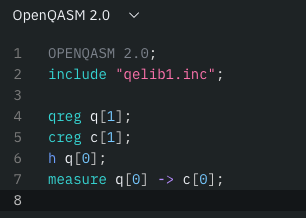
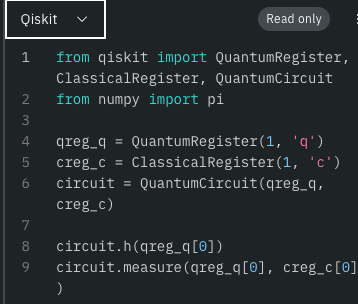
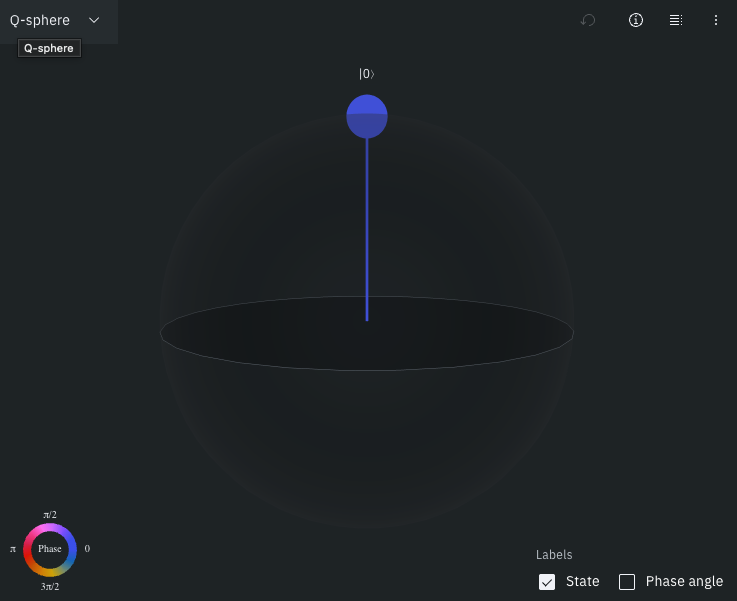
So how to we do it? We initialize a qubit, hit it with a Hadamard operation and then simply take a measurement.
I show this below using the IBM Quantum Platform. Here is the setup and what can be even run on existing cloud servers at IBM.
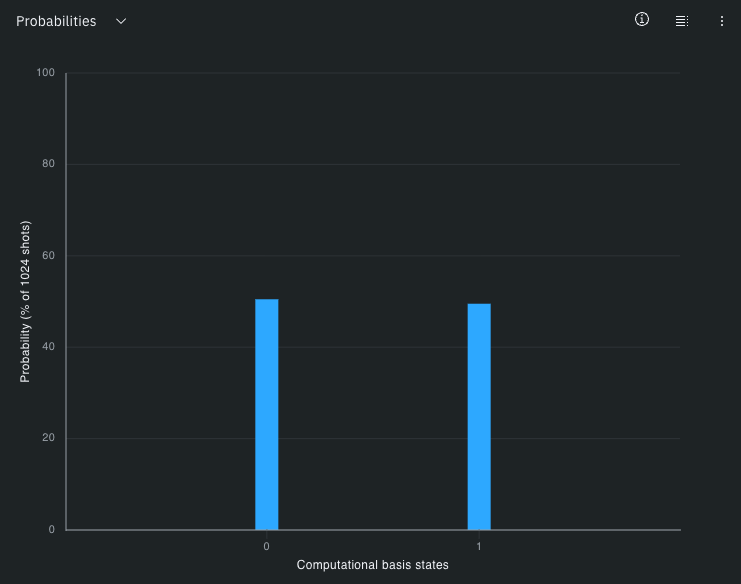
Clever readers will note that the distribution is not perfect… and ask themselves why.
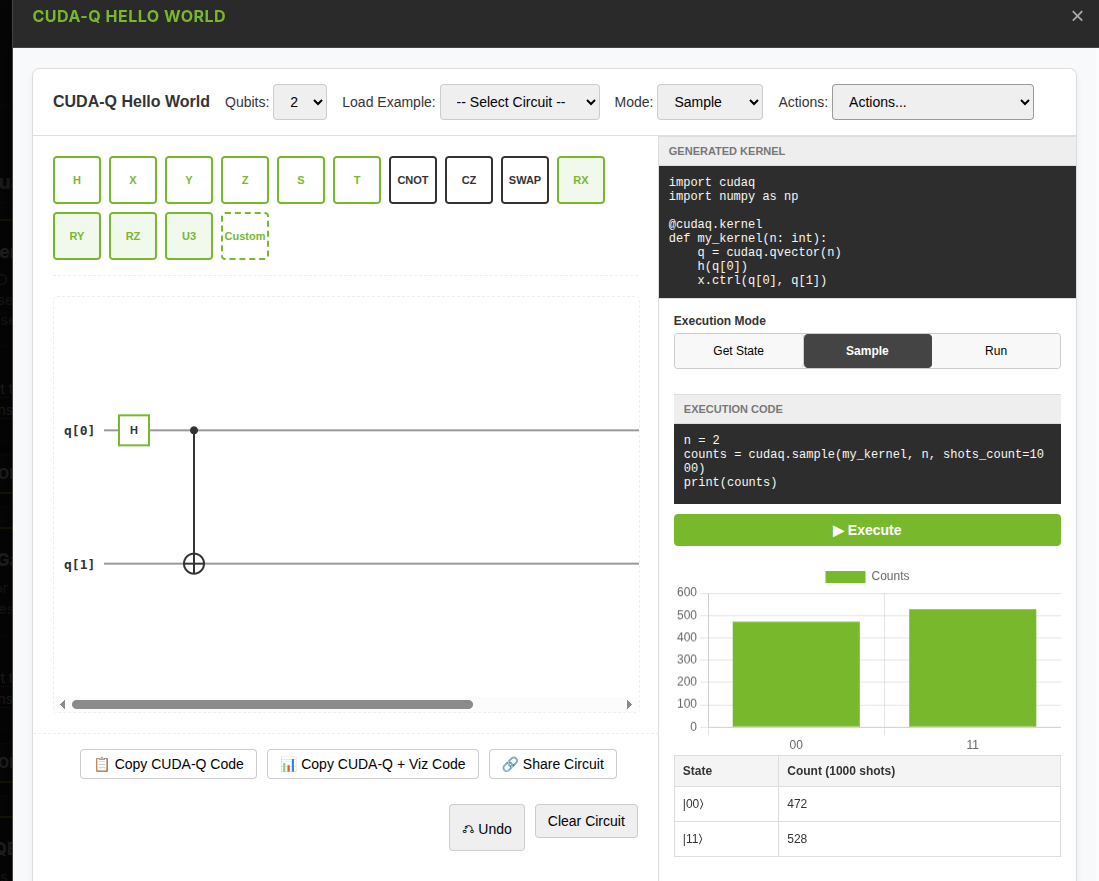
CUDA-Q Academic also offers a great visualization engine.
Here is a Bell state (showing entangled outputs of |00> or |11>):
My background in Quantum
I like to say that I've gone to college a few times. In the last 10 years or so I'm taken a handful of graduate classes in Mathematics at Portland State University. Professor Steven Bleiler taught my favorites including:
- MTH510: Games and Information (introduced quantized games)
- MTH610: Topics In Game Theory I & II (the topics were all quantized games and quantum formalizations)
- MTH510: Quantum Algorithms for Machines Learning and Data Science I (QA theory and applications with Qiskit)
Links & References
Quantum Supremacy by Michio Kaku
Qiskit Pocket Guide by Weaver and Harkins
Quantum Computing: An Applied Approach by Jack D. Hidary
Quantum Computation and Quantum Information ("Mike and Ike") by Nielsen and Chuang
Programming Quantum Computers by Johnston, Harrigan, and Gimeno-Segovia
https://nvidia.github.io/cuda-q-academic/visualization-gallery.html