
Where Are The Disruptomobiles?
It’s really hard to design products by focus groups. A lot of times, people don’t know what they want until you show it to them.
Christensen's technology disruption theory is probably clichéd now, over applied, applied too early, and often overhyped. Gartner has also published technology hype cycle charts for decades now, showing where disruptors or potential disruptors are on a hype cycle. Such a hype cycle had "autonomous vehicles" peaking in 2020 along with various alternative battery technologies, and various now standard safety features emerging into common use.
Gartner lines up technologies in a 5 phase wave:
- Innovation Trigger
- Peak of Inflated Expectations
- Trough of Disillusionment
- Slope of Enlightenment
- Plateau of Productivity

Electric vehicles are now well into the Plateau of Productivity, and are now shipping in large volumes and adoption continues to rise. In the parlance from another once popular technology marketing book, we've crossed the chasm into mainstream adoption. And so we've made it and the electrified future is here, right?
Sort of.
Where are the truly disruptive options, aka Disruptomobiles?
If we take a step all the way back to perhaps the first concept of a self-propelled vehicle, Da Vinci offered this (reconstructed here) concept over 500 years ago.
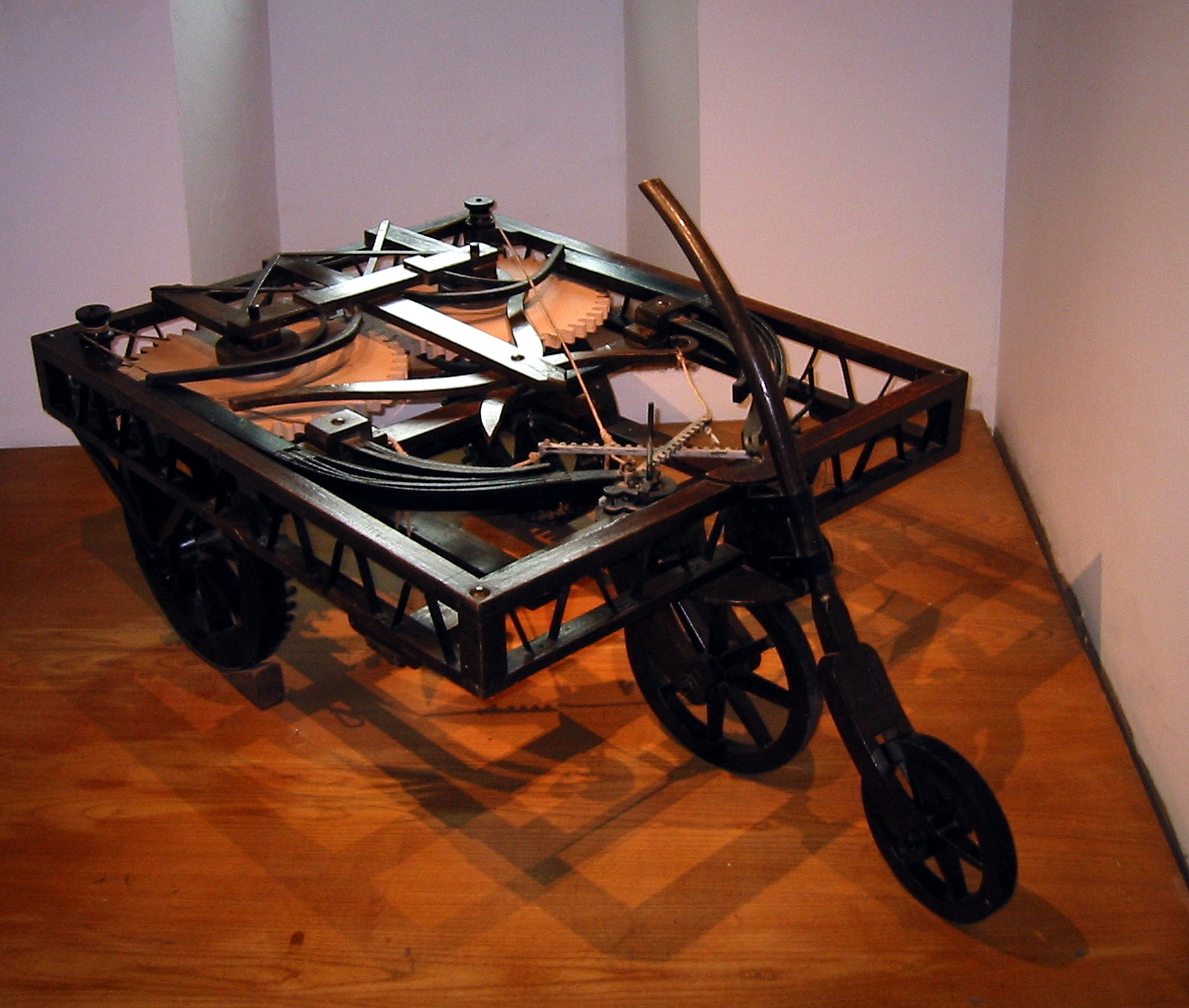
As Top Gear hilariously showed, there are cornering issues with 3 wheeled vehicles. So maybe we go with four instead. Consider that current electrified vehicles have some of the features of a disruptive technology, being somewhat simpler (as in composed of radically less total parts in a vehicle), and initially offering tiny and probably sub-acceptable ranges for everyday use. But we have the same automotive incumbents (outside of Tesla) making similar vehicles, with similar price points, made in similar factories with the same cost structures. The Ford 150 Lightning is a prime example of this.
What we are going to see next may be some actual change and radical simplifications.
I have a paper copy of the 7th edition of Contemporary Strategy Analysis (2010) by Robert M. Grant. Chapter 3 Industry Analysis discusses Threat of Entry and the principle sources of barriers to entry in an industry. Interestingly enough the first two are: Capital Requirements; and Economies of Scale. For capital requirements, Grant notes that "the cost of developing rockets and launch facilities make new entry highly unlikely." In Economics of Scale, we're told that the problem with new entrants in automobiles, "is high unit costs, or entering on a large scale and bearing the costs of underutilized capacity." And yet the same entrepreneur entered both industries with Space X and Tesla, both via technological change, creating in the case of Tesla the first successful (as in reached profitability and mass production) new American car company since Chrysler was founded in 1925.
Tesla started at the top end of the market with a sports roadster, moved to a luxury sedan and then continued to move down-market. They dealt with the high unit costs problem by offering a fundamentally different energy storage and propulsion solution vs. existing internal combustion engine vehicles, as well as delaying profitability for a very long time. It is also interesting that electric golf carts, despite predating Tesla by a few decades, have not grown up into city vehicles. The technological limitations limiting them to toys no longer exist. Lithium-Ion batteries, cheap electronic controls and motors all exist now.
But the real problem with a lot of Golf cart + options, is that they are plain ugly. And beauty has value in both design and for public adoption. Slate is the first start up I've seen with a concept that is both simple and beautiful. They plan to offer a one size fits all product that is radically simpler to assemble and build, although only moderately cheaper to buy.

A Slate is going to sell at half the cost of the average Toyota Rav4 or Tacoma. The latest and great Toyota hybrids flex in the opposite direction, using both gasoline and electric propulsion and reaching the pinnacle of the previous paradigm, adding dramatically more features and complexity, and invariably lowering reliability. The Tesla Cybertruck is a move in the wrong direction another way, as it's huge, expensive, and ugly.
Making a pickup truck with a frunk solves a problem with regular cab pickups, offering hidden secured storage which traditionally lacks in regular cab pickups. Electrified, there is no traditional need for this compartment, but the image of a pickup is now burned into the mind of the consumer and so this product just looks right.
Innovative, simple, affordable and exciting autos... I'm ready.